The best day trading journal is the one you still fill in on your worst day. That rules out anything that takes 30 minutes per session. This template is built to take a few minutes: a short pre-market note, a handful of fields per trade, and a two-minute wrap-up after the close.
Part 1: Before the Session (2 minutes)
Write this before the open, while you are still calm:
- Market context: higher-timeframe trend, key levels, scheduled news.
- Planned setups: which one or two setups you are looking for today.
- Max loss for the day: in R and in money. When you hit it, you stop.
- State: sleep, focus, anything that might affect your decisions.
The daily maximum loss is the most important line. It is the rule that protects you from your own worst session — see risk management strategies for day traders for how to set it.
Part 2: For Every Trade (under a minute each)
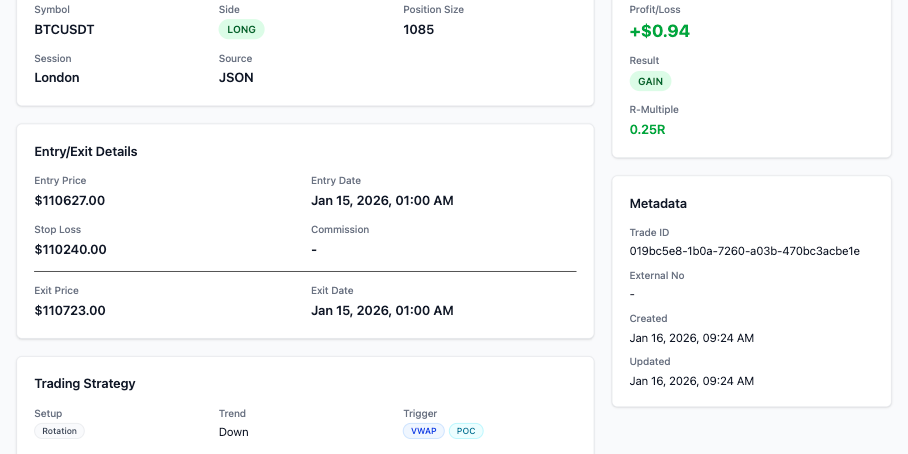
Log these fields for every trade, win or lose:
- Symbol and direction
- Entry, exit and stop loss — the stop is what makes R-multiple possible.
- Position size — sized from your stop with a position size calculator.
- Setup and trigger — what you saw and what made you enter.
- Session and time — open, midday, close, pre-market.
- Targets hit — TP1, TP2, runner, or stopped out.
- Mistakes — moved stop, chased, entered early, oversized, no confirmation.
- Emotion — calm, rushed, FOMO, revenge, confident.
- Grade A–F — how well you executed the plan, independent of the result.
- Chart screenshot — so the review shows what you saw at entry.
Grading execution separately from outcome is the habit that changes the most. A losing A-trade is a good trade. A winning D-trade is a future problem.
Part 3: After the Close (2 minutes)
- Day result in R and number of trades.
- Did you respect the daily max loss? Yes or no.
- Best trade and worst trade — one line each on why.
- One lesson — a single sentence you would tell yourself tomorrow morning.
Part 4: The Weekly Review (20 minutes)
Daily logging collects the data. The weekly review is where it turns into improvements. Once a week, answer these questions from your journal:
- Which setup had the highest expectancy this week, and which had the lowest?
- Which mistake cost the most R in total?
- How did trades graded A–B perform compared with C–F?
- Is there a time of day where results consistently drop?
- What is the one change for next week?
One change per week is enough. Ten small fixes over a quarter will do more than a complete strategy rewrite. For a deeper routine, see how professional traders review their trades.
Spreadsheet or Journal App?
You can run this template in a spreadsheet, and many traders start there. The friction shows up at review time: segmenting by setup, mistake and grade means building pivot tables every week. A dedicated day trading journal stores the same fields and calculates the breakdowns for you. The trading journal vs spreadsheet comparison covers the trade-offs.
Conclusion
A day trading journal template is not about collecting as much data as possible. It is about collecting the few fields that explain your results — risk, setup, mistakes, emotion and execution grade — every single day, and reviewing them every week.
CTA: Alpha Charts has every field in this template built in, from setup and trigger to mistakes, emotion and grade. Log your next session there and run your first weekly review on Friday.